1.Introduction
2205 duplex stainless steel fasteners solve a problem that 304 and 316L cannot: delivering high strength, chloride corrosion resistance, and stress corrosion cracking (SCC) immunity in a single bolt. From offshore platform flange connections to chemical reactor pressure bolts and pulp bleaching structural hardware, standard austenitic grades consistently fall short—lacking either the mechanical strength or the pitting resistance these environments demand. Conversely, high-alloy nickel-based metals solve the technical issues but bring prohibitively high costs.
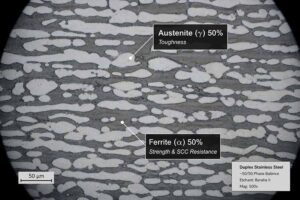
2205 Duplex Stainless Steel is a standardized solution designed expressly to fill this engineering void. By precisely controlling its chemical composition, it forms a microstructure consisting of approximately 50% ferrite and 50% austenite. This phase balance successfully combines the performance benefits of both stainless steel types into a single material.
This white paper is tailored for fastener procurement managers, mechanical engineers, and technical project leads. It systematically outlines the metallurgical principles, chemical specifications, mechanical limits, manufacturing best practices, and procurement checklists for 2205. Ultimately, it serves as a traceable technical guide for cross-border B2B sourcing and engineering material selection.
2: 2205 Duplex Stainless Steel: Material Definition and Metallurgy
2.1 What is Duplex Stainless Steel?
Duplex Stainless Steel features a microstructure where the ferrite phase (α) and austenite phase (γ) coexist in a roughly 1:1 ratio. This unique dual-phase structure allows the material to inherit the high strength and SCC resistance of ferrite, along with the notable toughness and ductility of austenite.
Within the duplex family, 2205 is categorized as a “Standard Duplex” grade, named after its nominal composition of 22% chromium and roughly 5% nickel. It currently stands as the most widely used and highly standardized duplex grade globally, often regarded as the universal benchmark for duplex steels.
2.2 UNS S32205 Designation and International Standards
In international trade and technical specifications, the designated UNS number for 2205 is S32205. (An earlier version, S31803, has a slightly different chemical range, but S32205 is now the industry mainstream.) The primary standard governing this material is ASTM A240/A240M, which dictates core technical parameters such as chemical composition, mechanical properties, and heat treatment conditions.
2.3 Why the 50/50 Phase Balance Matters
The exceptional performance of 2205 is rooted in its 50α/50γ phase balance. This balance does not occur naturally; it is carefully engineered through a specific solution annealing process. During manufacturing, the material must be heated to a temperature between 1900°F and 1922°F (1040°C to 1080°C) and then rapidly quenched in water to lock in the ideal 50/50 ratio.
If the treatment temperature is too high (exceeding 2000°F / 1093°C), ferrite levels will spike, sharply reducing the material’s toughness. If the phase balance is disrupted during processing, both corrosion resistance and mechanical integrity will severely degrade. This metallurgical reality dictates that the processing window for 2205 fasteners is far tighter than that for standard austenitic steels, demanding strict process control from manufacturers.
3: 2205 Chemical Composition per ASTM A240
3.1 ASTM A240/A240M Standard Composition
Under ASTM A240/A240M, the chemical makeup of 2205 must fall within these limits:
| Element | Symbol | Weight Percentage (wt%) |
|---|---|---|
| Carbon | C | ≤ 0.03 |
| Silicon | Si | ≤ 1.00 |
| Manganese | Mn | ≤ 2.00 |
| Phosphorus | P | ≤ 0.03 |
| Sulfur | S | ≤ 0.02 |
| Chromium | Cr | 22.0 – 23.0 |
| Nickel | Ni | 4.5 – 6.5 |
| Molybdenum | Mo | 3.0 – 3.5 |
| Nitrogen | N | 0.14 – 0.20 |
During procurement inspections, the actual values of Cr, Mo, Ni, and N are the primary focus. Any deviation in these four key elements serves as a red flag that phase balance or corrosion resistance may be compromised.
3.2 The Role of Key Alloying Elements
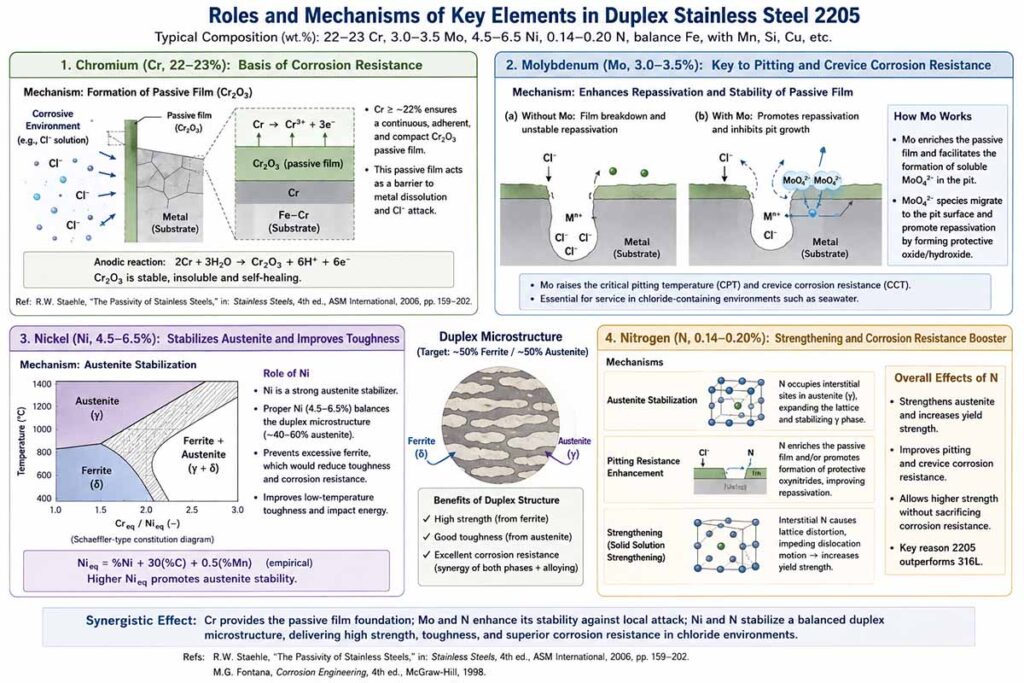
Chromium (Cr, 22-23%) provides the foundation for 2205’s corrosion resistance. It forms a dense, passive oxide layer (Cr₂O₃) on the surface, acting as a foundational barrier. Exceeding the 22% threshold is crucial for the alloy to endure chloride-rich environments.
Molybdenum (Mo, 3.0-3.5%) is the critical defense against pitting and crevice corrosion. In seawater or chloric media, Mo dramatically speeds up the repassivation of the surface film if it incurs local damage. This self-healing boost is the core reason 2205 performs brilliantly in marine engineering.
Nickel (Ni, 4.5-6.5%) primarily acts as an austenite stabilizer. Precise nickel content ensures the phase balance does not tilt too far toward ferrite, while providing the material with necessary low-temperature toughness.
Nitrogen (N, 0.14-0.20%) is the defining element that sets 2205 apart from earlier duplex generations. Nitrogen stabilizes the austenite phase, sharply enhances pitting resistance, and bolsters yield strength, making it a major factor in why 2205 consistently outperforms 316L.
3.3 PREN: Calculating Pitting Resistance for 2205
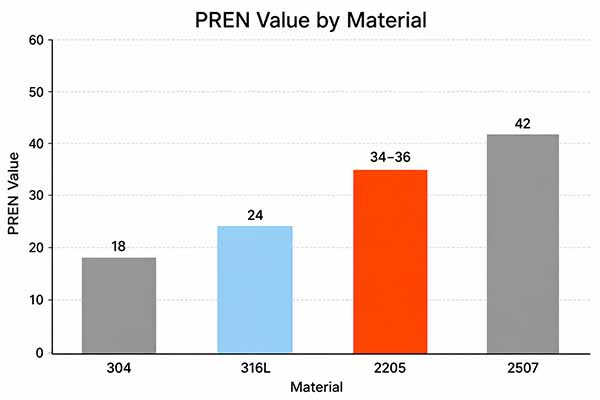
The global engineering community measures a stainless steel’s resistance to pitting using its PREN. The calculation formula is:
PREN = %Cr + 3.3 × %Mo + 16 × %N
Based on the median composition of 2205, its PREN typically sits between 34 and 36. This value is significantly higher than that of 316L stainless steel (approx. 24-26) but lower than Super Duplex 2507 (approx. 40-42), positioning it clearly within the “standard duplex” performance tier.
4: Mechanical Properties of 2205 Duplex Steel Fasteners
4.1 ASTM A240/A240M Mechanical Specifications
Based on ASTM A240/A240M, the minimum mechanical properties for 2205 (UNS S32205) are:
| Property | Metric | Imperial |
|---|---|---|
| Tensile Strength (min) | 655 MPa | 95 ksi |
| Yield Strength (min) | 450 MPa | 65 ksi |
| Elongation (in 2 inches) | 25% | 25% |
| Brinell Hardness (max) | HB 293 | HB 293 |
| Rockwell Hardness (max) | HRC 31 | HRC 31 |
4.2 The Engineering Value of High Strength
The standout mechanical feature of 2205 is its minimum yield strength of 450 MPa—more than double that of common austenitic steels like 304 and 316L (which hover around 205 MPa).
For fastener design, this characteristic offers two valuable engineering pathways:
- Weight Reduction for the Same Load: Maintaining the same safety factor, engineers can specify smaller 2205 bolts, cutting down total structural weight. This is highly significant for weight-sensitive applications like offshore platforms and marine vessels.
- Increased Capacity for the Same Size: Using the exact same bolt dimensions, 2205 fasteners can accommodate much higher preloads and working stresses, providing a greater safety margin for the overall structure.
4.3 Operating Temperature Range
The optimal operating temperature range for 2205 is between -50°F and +600°F (approx. -46°C to +316°C). Within this window, the material maintains its dual-phase stability and mechanical prowess. If temperatures drop below -50°F—especially for welded assemblies—strict low-temperature impact testing is mandatory, as the ferrite phase undergoes a brittle transition in extreme sub-zero conditions.
It must be emphasized that 2205 is not recommended for prolonged use above 316°C. At higher temperatures, the material is highly susceptible to 475°C embrittlement and the precipitation of the sigma (σ) phase, causing toughness to plummet.
4.4 Resistance to Corrosion Fatigue and SCC
2205 truly excels when subjected to the combination of cyclic loading and corrosive chemicals. Its high yield strength, coupled with its dual-phase makeup, results in extraordinary corrosion fatigue strength.
This trait is vital for hardware facing dual-threat conditions (“corrosive environment + load cycling”), such as reactor bolts in chemical plants, offshore platform couplings, and cyclic stress parts in wastewater treatment. While standard austenitic stainless bolts easily fall victim to Chloride-Induced Stress Corrosion Cracking (Cl-SCC) in these environments, 2205 effectively resists this typical failure mode thanks to its ferrite matrix.
5: Manufacturing and Processing Guidelines for 2205 Fasteners
5.1 Hot Forming Temperature Window for 2205
Hot forming (e.g., hot heading, hot thread rolling) of 2205 must be executed within a strictly controlled temperature window. The recommended interval runs from 1750°F to 2250°F (954°C to 1232°C), where the material boasts optimal plasticity.
Manufacturers must adhere to two hard boundaries:
- Upper-Limit Risk: Exceeding 2250°F makes 2205 prone to hot tearing, which creates micro-cracks under the fastener head or base of the threads.
- Lower-Limit Risk: Below 1750°F, the austenite phase may fracture. Moreover, driven by dropping temperatures and physical deformation, detrimental intermetallic phases (like the sigma phase) form rapidly, severely compromising toughness and corrosion resistance.
Immediately following hot forming, fasteners must be solution annealed at no less than 1900°F and rapidly cooled via water quench. This mandatory step restores the vital phase balance, toughness, and anti-corrosive properties, and cannot be bypassed.
5.2 Cold Heading and Thread Rolling Considerations
2205 responds well to cold forming, easily handling typical procedures like bolt cold heading and thread rolling. However, possessing inherent higher strength and hardness, 2205 demands substantially more forming force than standard austenitic steel.
Engineers must account for two key issues:
- Springback Compensation: High yield strength means 2205 will display significant springback after cold forming. Tooling dies must incorporate sufficient over-bending allowances, otherwise finished dimensions will drift out of tolerance.
- Equipment Capacity: Standard austenitic cold heading machinery might lack the necessary power when processing 2205. Production runs demand a thorough evaluation of machine tonnage limits.
5.3 Solution Annealing and Heat Treatment Requirements
Heat treating 2205 leaves practically zero room for error. Any heat treatment must take place at no lower than 1900°F, followed instantly by a rapid water quench.
This rule applies equally to solution annealing and stress relief procedures. A common engineering fallacy is attempting to stress-relieve 2205 at conventional lower temperatures (e.g., 600°C to 700°C) based on standard steel logic. Doing so drops 2205 straight into the intermetallic precipitation zone, devastating material properties. Traditional low-temperature stress relieving is strictly not recommended for 2205 fasteners. If stress relief is structurally imperative, only a full high-temperature solution anneal combined with a water quench should be utilized.

5.4 Machinability of 2205 vs. 316L
When evaluating machinability on high-speed equipment, 2205 handles feed rates and cutting speeds roughly on par with 316L. However, if utilizing carbide tooling, cutting speeds should be reduced by about 20% compared to 316L.
This stems from 2205’s pronounced work-hardening tendency. Machining best practices include:
- Always employing sharp tooling and generous fluid coolant.
- Taking decisive, consistent cuts to avoid leaving a work-hardened layer on the piece.
- Ensuring maximum machine rigidity and stability, as vibrations critically degrade finished quality.
5.5 Welding 2205 Duplex: Filler Metal and Procedure Essentials
Excellent weldability is a major factor driving the widespread footprint of 2205 in engineering applications.
The core objective of any 2205 welding procedure is clear: Ensure the weld metal and the Heat-Affected Zone (HAZ) perfectly maintain a phase balance, strength, and corrosion resistance comparable to the base metal post-weld. This typically requires:
- Selecting proper filler metal (e.g., ER2209, featuring enriched nitrogen to compensate for austenite loss in the HAZ).
- Rigidly limiting interpass temperatures (generally keeping them below 150°C).
- Strictly monitoring heat input.
- Implementing post-weld solution annealing, depending upon service conditions.
6: Intermetallic Precipitation Risks and Quality Control
6.1 The Danger Zone for Phase Precipitation
Like all duplex steels, 2205 carries the risk of precipitating intermetallic phases. Detrimental formations (principally sigma σ and chi χ phases) emerge aggressively between 1300°F and 1800°F (704°C to 982°C), reaching their fastest precipitation rates near 1600°F (871°C).
Once present in the microstructure, these phases degrade toughness and corrosion resistance without any visible indication—standard visual inspections cannot detect this damage. Consequently, any manufacturing step that allows 2205 to dwell within this temperature window must be rigorously evaluated and strictly controlled.
6.2 ASTM A923 Testing Standards
To verify the presence or absence of harmful intermetallic phases in 2205, the broader engineering sector relies on ASTM A923 as the gold standard testing protocol. This standard defines three methods:
- Method A: Metallographic testing (serving as an initial screening)
- Method B: Charpy impact testing (to verify toughness)
- Method C: Ferric chloride corrosion testing (to confirm pitting resistance)
7:Key Applications for 2205 Duplex Stainless Steel Fasteners
Anchored by its core traits—high strength, defense against chloride pitting, SCC immunity, and corrosion fatigue resistance—2205 fasteners have secured a critical role across several demanding sectors:
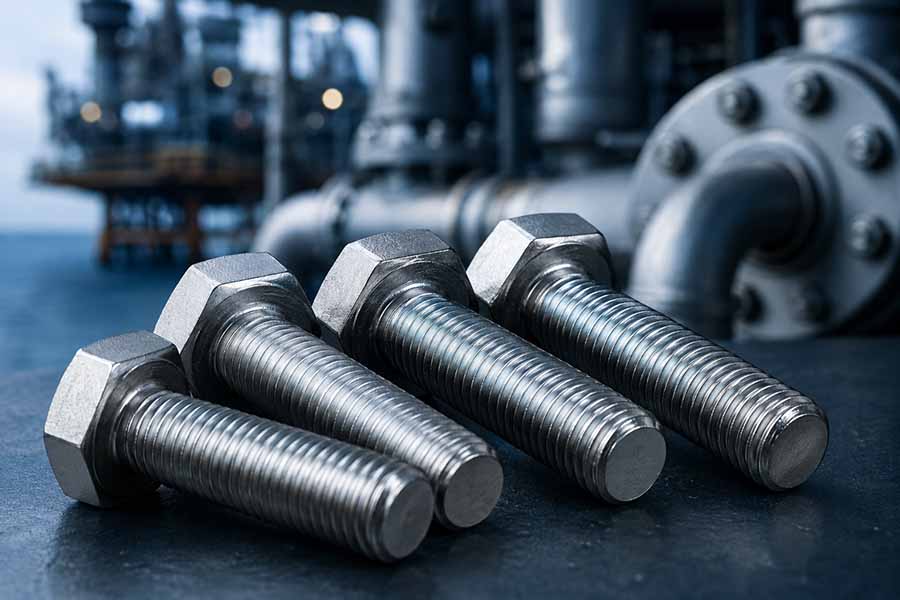
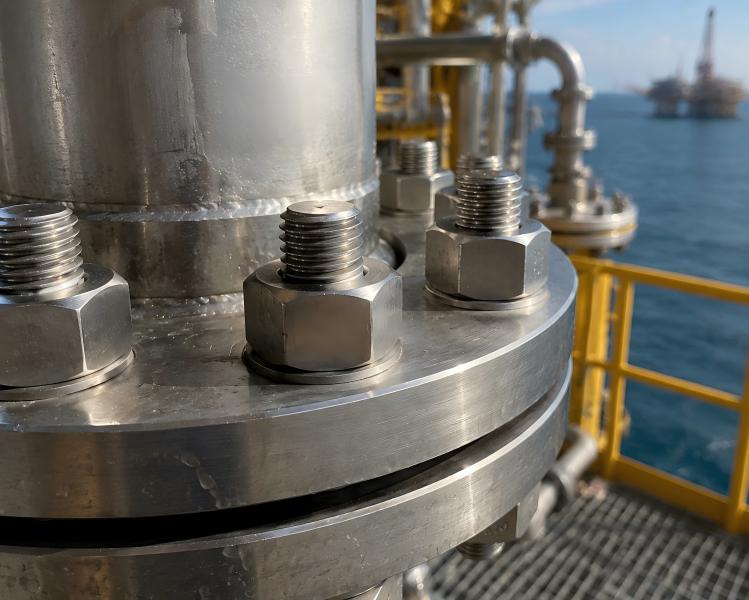
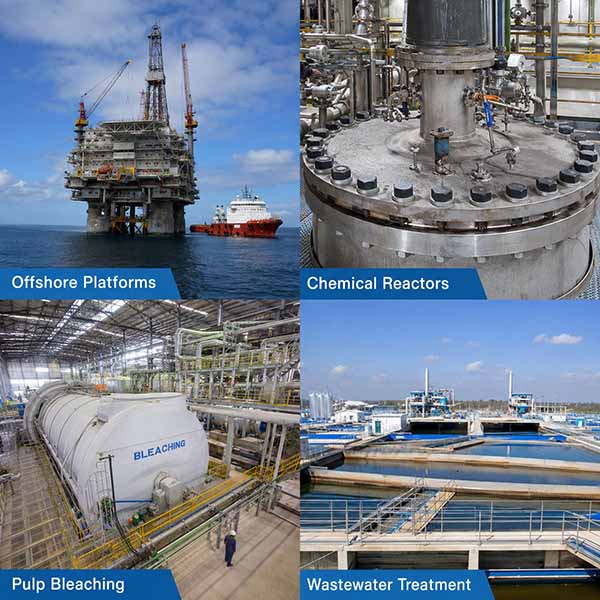
- Oil & Gas Industry: Offshore platform flange bolts, heat exchanger fittings, and pipeline hardware. This environment seamlessly showcases 2205 against the simultaneous triple-threat of chlorides, high pressures, and cyclic forces.
- Chemical Processing Industry: Pressure vessel tie-downs, high-pressure storage tank fasteners, pipeline flanges, and heat exchanger bolting.
- Wastewater Treatment Systems: Core structural fasteners submerged within chlorine-rich environments.
- Pulp & Paper Industry: Fasteners operating inside classifiers, bleach plants, and stock handling systems. Extreme chloride concentrations generated in bleaching stages make 2205 indispensable.
- Marine & Shipbuilding: Marine cargo tank securing and structural fastening on oceanic platforms.
- Food Processing Equipment: Applied as high-strength, sanitary connectors in aggressive salt and acid-heavy processing conditions.
- High-Strength Rotary Components: Tie-downs for rotary shafts, press rolls, mixing blades, and impellers where high-cycle fatigue meets a constant flux of corrosive fluids.
8: 2205 Fastener Procurement and Acceptance Checklist
8.1 Mandatory Material Test Certificate (MTC) Checks
When sourcing 2205 fasteners across international borders, the Material Test Certificate (MTC) acts as the definitive basis for acceptance. Buyers should meticulously verify the following parameters:
Measured Values of Chemical Composition
- Scrutinize the core four: Cr (22.0–23.0%), Mo (3.0–3.5%), Ni (4.5–6.5%), and N (0.14–0.20%).
- Confirm that Carbon meets the low-carbon threshold (C ≤ 0.03%).
- Require suppliers to provide lab data fully traceable to the original Heat Number.
Mechanical Properties Testing
- Tensile Strength ≥ 655 MPa
- Yield Strength ≥ 450 MPa
- Elongation ≥ 25%
- Hardness ≤ HRC 31 / HB 293
Intermetallic Phase Testing
- Ensure results align with ASTM A923 testing parameters.
- For mission-critical implementations, demand a testing combination linking Method A with either Method B or C.
8.2 Vendor Vetting and Process Capability
Paperwork covers only half the equation; validating the supplier’s practical shop-floor capabilities is equally paramount:
- Solution Annealing Thermal Controls: Validate if the vendor realistically possesses stable control metrics for 1900°F+ temperatures. Furthermore, verify whether their crane-to-quench transfer time complies strictly with cooling requirements.
- Heading Process Capability: Check whether the vendor utilizes upgraded machine tonnage robust enough to conquer high-strength 2205 wire, and confirm their tracking index for mold life decay and springback experience.
- Traceability Protocol: Assess whether an unbroken, end-to-end audit trail tracking raw billet heat numbers systematically to final finished batches is active.
- Third-Party Alignment: Clarify if they partner continuously with independent watchdogs like SGS, TÜV, or Bureau Veritas. In cross-border B2B engagements, this step forms the baseline structural foundation for commercial trust.
9:Conclusion
2205 duplex stainless steel fasteners are far from generic, off-the-shelf hardware. Cultivated uniquely for extreme scenarios, they thrive where high strength, pervasive corrosion, and SCC pressures intersect. When engineering footprints confront marine chloride environments, unyielding cyclic loads, and immense static weight concurrently, 2205 ensures a durable solution fully endorsed by international ASTM standards, supported by reliable global supply chains.
For procurement frameworks, grasping 2205’s chemical guardrails, mechanical benchmarks, and production nuance stands as the primary blueprint for gauging vendor legitimacy and dodging operational defects. For mechanical engineers, decoding the material’s thermal limits, strict phase balance thresholds, and precise weld traits translates directly to field reliability and safety.
When interfacing with potential supply chain partners, incorporating the technical requirements from this white paper alongside traditional RFQ packages delivers immense tactical value.Specifying ASTM A240/A240M and ASTM A923 compliance in your RFQ immediately filters out underqualified producers and establishes a clear, enforceable quality benchmark for dispute resolution.
Ready to source 2205 duplex stainless steel fasteners with full MTC traceability and ASTM A923 certification? [Contact our engineering team] for a technical consultation and competitive bulk pricing.