1.Introduction: Why Engineers Shortlist 310 and 310S for High-Temperature Bolting
Above 700°C, the rules change. Standard 304 and 316 stainless steel fasteners begin to suffer from oxide scale spalling and creep relaxation within months, leaving engineers searching for a true heat-resistant alternative. This is exactly where grades 310 and 310S enter the shortlist — and where most procurement teams need clarity on which one fits their service envelope.
In industrial furnaces, ethylene cracking units, and combustion chambers operating above 700°C, the engineering shortlist narrows quickly. Grades 310 and 310S almost always make the cut. Belonging to the same alloy family, they share a single mission: delivering an engineering balance of high-temperature oxidation resistance and moderate elevated-temperature strength.
2. Chemical Composition: One Skeleton, Two Carbon Limits
If you break down 310 and 310S, you’ll see they share identical alloy skeletons. The only element that is strictly restricted is carbon. While this difference comes down to just a couple of decimal places, it significantly rewrites the operating boundaries of the material in high-temperature environments.
| Element | 310 (UNS S31000) | 310S (UNS S31008) |
|---|---|---|
| C (Carbon) | ≤ 0.25% | ≤ 0.08% |
| Cr (Chromium) | 24.0–26.0% | 24.0–26.0% |
| Ni (Nickel) | 19.0–22.0% | 19.0–22.0% |
| Mn (Manganese) | ≤ 2.0% | ≤ 2.0% |
| Si (Silicon) | ≤ 1.5% | ≤ 1.5% |
| P / S | ≤ 0.045 / ≤ 0.030% | ≤ 0.045 / ≤ 0.030% |
2.1 The Engineering Role of the High Cr/Ni Skeleton (24–26% Cr, 19–22% Ni)
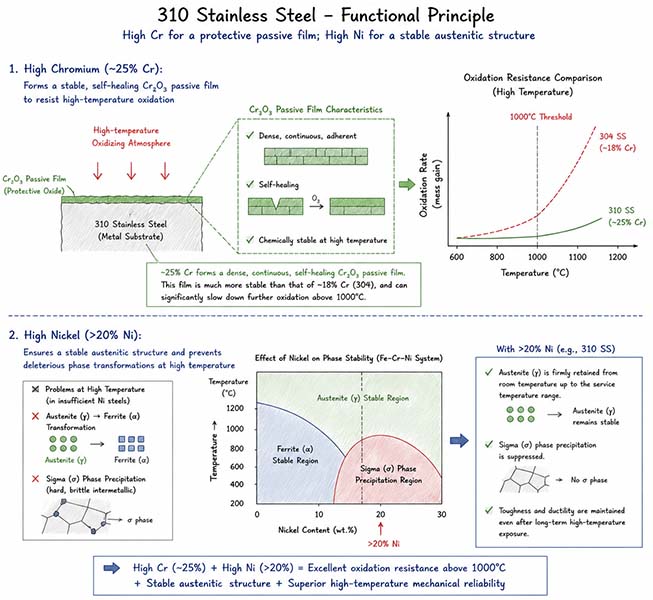
Chromium is boosted to around 25% to build a dense, continuous, and self-healing passive film (Cr₂O₃)—a protective layer that seals the base metal away from corrosive media. This passive film is highly resilient compared to the oxide layer of 304 stainless steel fasteners (which only contains 18% chromium) and can dramatically delay further oxidation of the base metal. Once temperatures cross the 1000°C threshold, it is this chromium-rich layer that determines whether the fastener survives.
Pushing the nickel content past 20% solves another major issue: structural phase stability. For fasteners exposed to high heat, if the internal structure transforms from austenite to ferrite, or if it precipitates the brittle “sigma phase” (an intermetallic compound that makes high-temp exposed metals shatter like glass), toughness drops off a cliff. High nickel firmly locks in the austenitic structure, ensuring the metal remains stable from ambient conditions all the way to its extreme thermal limits.
2.2 The Design Logic Behind Carbon Differences (310 ≤0.25% vs 310S ≤0.08%)
Carbon acts as a double-edged sword. In 310, retaining a higher carbon content provides superior creep strength (the ability of a material to withstand slow deformation under prolonged thermal stress). To picture this: finely dispersed carbide particles act like microscopic pins—creating a “pinning effect” that stops metal atoms from sliding past one another under high heat. Macroscopically, this keeps bolts from gradually stretching or loosening.
However, if the material remains within the sensitization temperature zone of 425–870°C for an extended period, this sword cuts the other way. Carbon bonds with chromium to form Cr₂₃C₆ carbides that gather along the grain boundaries. Consequently, the chromium intended for fighting corrosion is locally hijacked, creating a “chromium-depleted zone.” Deprived of its protective film, these grain boundaries become prime targets for corrosive attacks—a phenomenon known as intergranular corrosion.
By capping carbon at 0.08%, 310S tackles the root cause of carbide precipitation. Without excess carbon, the chromium remains intact at the grain boundaries. The trade-off is a slight dip in high-temp creep strength, but the payoff is excellent weldability and long-term corrosion resistance. That is what the “S” suffix stands for: it’s not a brand-new material, just the “low-sensitization” version of the 310 grade.
3. Physical and Mechanical Baseline Properties
At room temperature, both 310 and 310S boast practically identical mechanical specs. Their true differences surface during long-term thermal exposure, not on their baseline factory test sheets.
| Property | Typical Values (Solution Annealed) |
|---|---|
| Tensile Strength (σb) | ≥ 515 MPa |
| Yield Strength (σ0.2) | ≥ 205 MPa |
| Elongation (δ5) | ≥ 40% |
| Hardness | ≤ 95 HRB |
| Density | 7.9 g/cm³ |
| Melting Point | 1400–1450°C |
| Elastic Modulus (20°C) | 200 GPa |
| Thermal Conductivity (100°C) | ~ 14 W/m·K |
| Thermal Expansion Coeff. (20–600°C) | ~ 17 × 10⁻⁶ /K |
Here is a detail often overlooked by procurement: the thermal expansion coefficient of the 310 family is significantly higher than that of carbon steel and ferritic stainless steel. When used for multi-material flange connections, thermal cycling will trigger unignorable preload variation (the clamping force shifting as the bolt repeatedly expands and contracts). Engineers must factor this into torque calculations during the design stage.
4. High-Temperature Service: The Core Value of the 310 Family
4.1 Oxidation Resistance vs. Extreme Temperatures (Continuous / Intermittent)
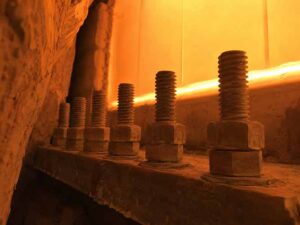
In continuous operations, 310/310S can comfortably handle up to roughly 1150°C. For intermittent operations, the limit drops to about 1035°C in the short term. Ironically, intermittent heating is actually harsher on the material. Constant heating and cooling trigger thermal expansion and contraction, forcing the oxide layer into cycles of stress cracking and spalling (flaking off entirely), which accelerates the consumption of the base metal.
We once received feedback where a customer installed 310S bolts on a furnace door hinge facing two complete heating/cooling cycles daily. Within three years, severe scale delamination occurred. This wasn’t a material failure; the operational conditions simply exceeded the harsh limits of intermittent oxidation.
4.2 Resistance to Sulfidation and Carburization
In sulfur-rich exhaust gases and moderate carburizing atmospheres, the heavy nickel content of the 310 family presents a subtle paradox. On one hand, nickel boosts carburization resistance (blocking destructive carbon atoms from infiltrating the metal), making these grades robust around ethylene cracking furnaces and hydrotreaters. However, in highly reducing sulfur-rich atmospheres, the high nickel content becomes a liability. Nickel reacts with sulfur to form a low-melting Ni-S eutectic phase that softens at around 600°C, accelerating component failure. It is also worth noting that 310/310S contains no molybdenum, which means pitting and chloride stress corrosion resistance are significantly weaker than 316 — a critical caveat for fasteners exposed to wet chloride environments. This low-melting-point compound softens at just 600°C, actively speeding up failure.
Instead of defaulting to the mindset of ‘high heat equals 310S,’ we highly recommend providing the exact gas composition to your material engineers during the RFQ stage if your fasteners are heading into a sulfur-heavy flue gas environment. In moderately corrosive but lower-temperature service, 316 stainless steel fasteners or duplex 2205 bolts often deliver better cost-performance than over-specifying 310S.
4.3 Cryogenic Applications: The Often Overlooked Side
Many buyers pigeonhole 310S strictly for heat applications. But it shines at sub-zero extremes as well. Its fully austenitic structure maintains excellent toughness even in liquid nitrogen (-196°C), and its magnetic permeability is extremely low. This makes it an ideal candidate for applications requiring an overlap of cryogenic temperatures and minimal magnetic interference.
5. Key Differences: How Carbon Reroutes the Engineering Paths of 310 and 310S
5.1 Sensitization and Intergranular Corrosion Risk
If your fasteners operate in the 425–870°C range (like heat treatment furnace grates or cat-cracker bolts) over long periods, the high carbon in 310 will relentlessly precipitate carbides at the grain boundaries. When such bolts are later removed and subjected to a standardized intergranular corrosion test such as ASTM A262 Practice A or E, the carbide network along grain boundaries becomes clearly visible under metallographic examination, often appearing as continuous etched ditches that map the grain structure. Under a metallographic microscope, you’ll see winding corrosion trenches mapping out the grain boundaries.
With 310S, low carbon drastically reins in this sensitization. Operating under the exact same conditions, its grain boundaries stay relatively stable for five or even ten years. Because of this, nearly all technical standards demand 310S over 310 whenever high-temp structural components require welding and face prolonged exposure in the sensitization zone.
5.2 Weldability and Post-Weld Treatment
Welding 310 is notoriously tricky: the Heat-Affected Zone (HAZ) adjacent to the weld sits perfectly in the sensitization temperature window, making carbide precipitation almost a certainty. Unless you follow up immediately with solution annealing (reheating past 1040–1080°C then water-quenching to dissolve the carbides back into the matrix), that welded joint becomes a corrosive ticking time bomb. Performing this post-weld heat treatment on massive bolted structures is exceptionally costly.
The welding window for 310S is highly forgiving. Using E310/ER310 filler metals inside the shop via SMAW or TIG welding, 310S routinely skips mandatory post-weld heat treatment while easily meeting most high-temp service demands. This operational perk often outweighs the sheer price difference between the materials on the procurement quote.
6. Fastener Production: Process Engineering Thoughts
6.1 Hot Forging and Cold Forming Windows (975–1175°C)
The ideal hot forging window lies tightly between 975–1175°C. Drop below 975°C, and deformation resistance surges, causing die life to plummet; creep above 1175°C, and you invite grain coarsening (large, weakened crystal grains) and overly thick scaling.
During cold heading, the high-nickel austenitic structure causes aggressive work hardening (the phenomenon where metal stiffens rapidly while losing plasticity during cold deformation) compared to standard 304. To make long-rod multi-station cold formed bolts, an intermediate softening anneal is usually a must. In our production line, forming 310S hex bolts above M16 almost strictly mandates a four-step rhythm: Cold Heading → Intermediate Annealing → Secondary Heading → Thread Rolling.
6.2 Solution Treatment and Passivation Checks
For the final heat-treat pass of finished fasteners, a 1040–1080°C solution anneal paired with a water quench is highly recommended. The goal of solution annealing is to crank the heat up until all stray carbides dissolve into the matrix, then flash-freeze that uniform state via water quenching. Sluggish cooling is the leading culprit for QC failures; it allows the material to linger in the sensitization zone, forcibly downgrading 310S back into a “sensitized 310.”
While surface passivation doesn’t exponentially upgrade the high-temperature limits of 310/310S, it reliably improves the room-temp corrosion resistance of fasteners during warehousing, shipping, and installation. We generally use nitric acid passivation baths and validate the integrity of the passivation layer with copper sulfate tests before shipping.
7. Quick Guide: Application Scenarios and Selection Basics
We built this cheat sheet from everyday project dialogues. While it cannot replace rigorous engineering evaluations, it serves as an excellent compass for the RFQ phase.
| Application Scenario | Preferred Grade | Key Criteria |
|---|---|---|
| Industrial grates, heat baskets | 310S | Prolonged sensitization zone exposure, complex weldments |
| Petrochemical cracking flanges | 310S | High temp + welded joints + moderate carburization |
| Power plant boiler hangers | 310S | Long lifespan requirements, cyclic oxidation resilience |
| Short-term hot tooling/fixtures | 310 | Unwelded applications demanding slight creep strength edges |
| LNG cryogenic valve bolting | 310S | Low magnetic permeability + low-temp toughness |
| Sulfur-rich exhaust duct fasteners | Needs Evaluation | Risk of Ni-S eutectic; Inconel evaluation recommended |

8. International Specs and Procurement Acceptance
Avoid painful disputes on delivery day by cementing standard alignment right from the order stage. The table below maps out equivalent 310/310S grades globally. Confirming that your MTC (Material Test Certificate, the chemical and mechanical test report issued by the steel mill) aligns precisely with your project documents is the first line of defense. (Note: It is advisable to refer to the standard grade cross-references in ASTM A276, JIS G4303, or EN 10088).
| Standard System | 310 Equivalent Grade | 310S Equivalent Grade |
|---|---|---|
| ASTM (USA) | UNS S31000 / Type 310 | UNS S31008 / Type 310S |
| JIS (Japan) | SUS310 | SUS310S |
| EN (Europe) | 1.4841 | 1.4845 |
| GB (China) | 06Cr25Ni20 | 022Cr25Ni20 |
When you receive the MTC, we recommend auditing at minimum these four metrics:
- Chemical composition (verify strict upper/lower caps on C, Cr, Ni)
- Room-temperature mechanical properties (tensile, yield, elongation)
- Intergranular corrosion evidence (ASTM A262 Practice A or E results)
- Solution heat-treatment records (temperature, hold time, quench medium)
Across hundreds of procurement discussions, the cost spread between raw 310 and 310S typically sits at 5–10%. Compared to the catastrophic cost of unplanned downtime or failure rework, this price gap is rarely the dominant variable in project decisions. What truly deserves your attention is verifying that the boundary conditions of your operating environment are described accurately on the RFQ.